Two New Favorite Free iPhone Apps!

Check out these two iPhone apps – the only thing you will need is an iPhone or iPod touch. Perhaps similar apps are out there for Blackberry and other phone users – there is always hope.

As a tap dance teacher, Metronome by Marketwall.com has been invaluable for those times when I need a steady beat, but can’t find the right tempo music or don’t want to clap my hands raw. It mimics a real metronome (which brings back nostalgia of my old piano lessons) and can tick tock its way from 1 beats per minute (why you would ever need that slow is beyond me) to 210bpm. If you have a stereo system with an audio headphone jack, you’re in business! It is a little tricky to accurately slide the little metronome weight thing (does that have a name?), but otherwise I am happy. It has a different tone for the downbeat of the measure, which you can change to 2/4, 3/4 or 4/4 timing.
There are a few other apps that do the same thing, but since I am pretty happy with the current one, I haven’t tried any of the other options. Comments are welcome if you have!

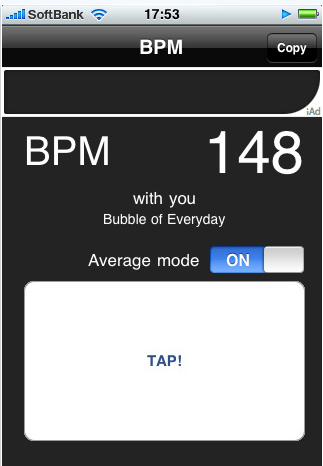
My second new favorite app is BPM by CHEEBOW. This handy little tool helps you determine the beats per minute in any song you can tap your finger to. It registers the BPM just after 3 taps and if you keep tapping, it will average your speed so even if you have an unsteady finger, it will give you a fairly accurate reading. I have used this to organize my dance class playlists by tempo, so I no longer go crazy trying to find a faster or slower song in the middle of class. You can add the BPM to your songs in iTunes under the “Get Info” option.

Share your favorite ‘apps’ in the comments!

See previous technology posts

Ballet Room Corners: Cechetti, RAD & Russian / Vaganova

Numbering the walls or corners in your classroom can be helpful for teaching all ages – from pre-schoolers who can learn to jump to “wall 3”, to ballerinas who travel from corner to corner, ballet schools have used a fixed number system for years.

However, each school has a different method for numbering their directions. Keeping them all straight can make your head spin!

So we’ve created a little cheat sheet for you to keep in your back pocket. For teachers of another discipline aside from ballet, you might consider adopting one of these numbering methods in addition to using tradition theater directions (upstage, downstage, etc).

Cechetti
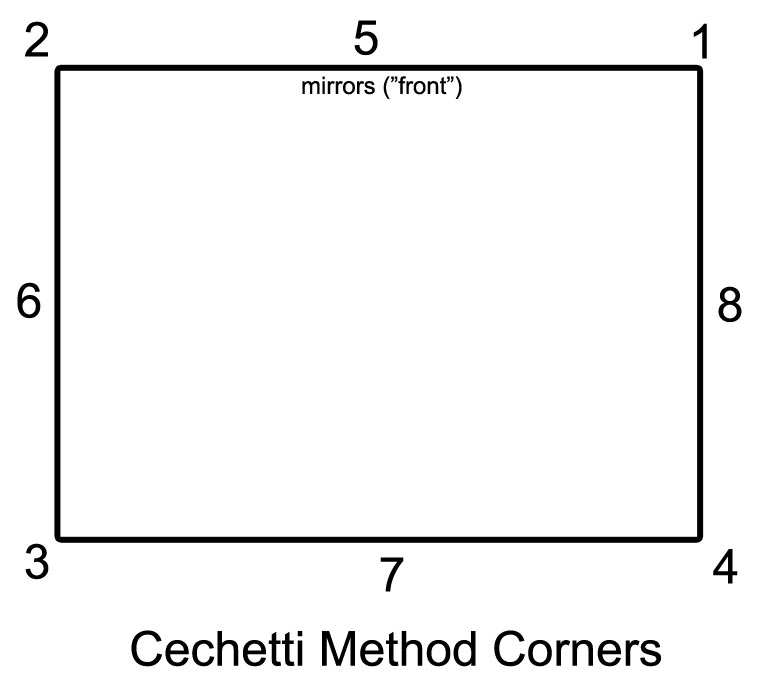
Cechetti starts with numbering the corners of the room first starting with the front right corner and going counter-clockwise (1-4). Then the front or “audience” is labeled 5 and the rest of the walls are numbered counter-clockwise as well.

Russian / Vaganova style

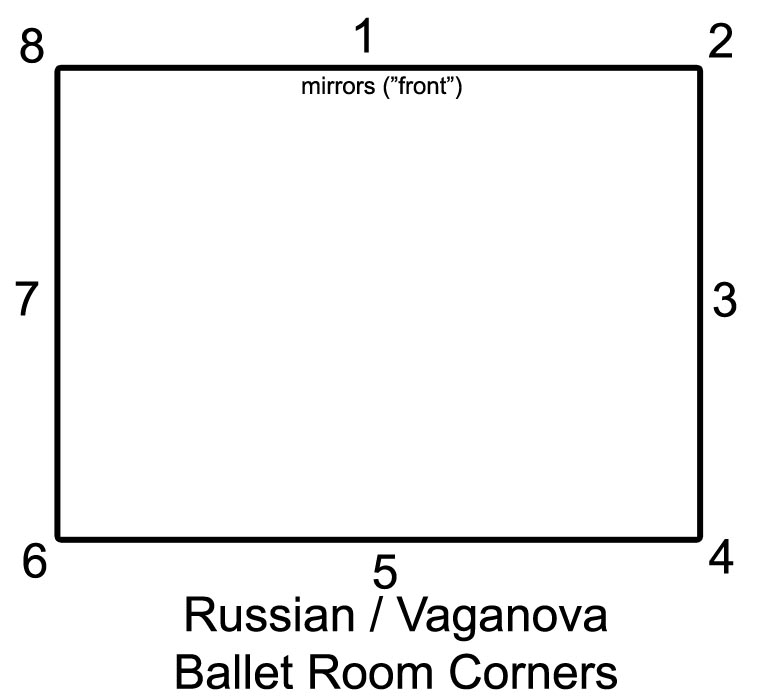
With this school, you start by facing the front and label that “1”. Then go around the room clockwise and label each point, so the front right corner is 2, the right wall is 3 and so on.

RAD Method
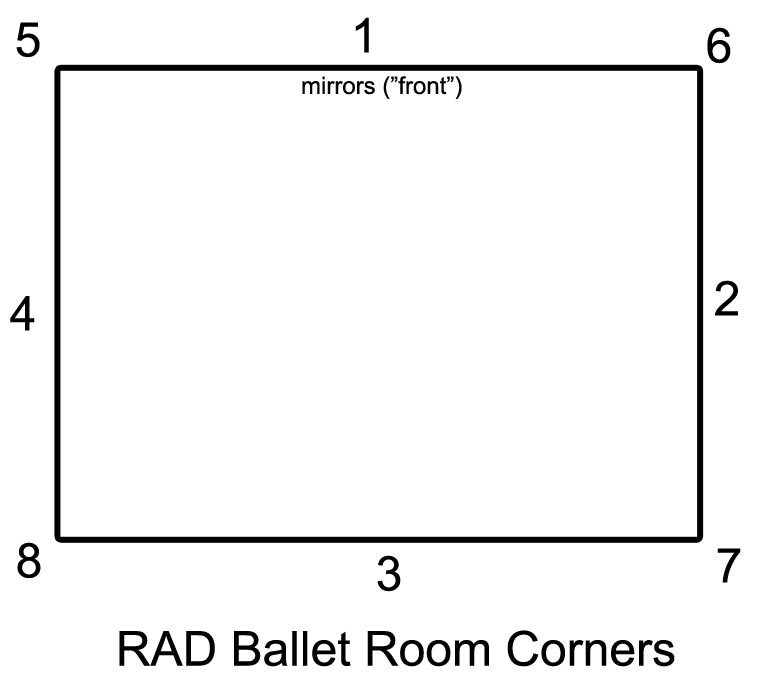
With RAD, you begin by numbering the walls first and then the corners, in a clockwise direction.

Teaching Tip: Hang large numbers on your studio walls / corners. Use the numbers in class – such as “let’s travel from corner 4 to corner 2”. Play 4-corners for a special treat for younger dancers. Halfway through the year, take one number down each week. Continue to play the games and use the corner names in class and see if the dancers remember which corner is which.

New Music Mondays: Ballet Music

Looking for some new ballet music?

Here are our current favorites:

1. Aly Tejas – Music for Ballet Class III Music

Described as “haunting” and “beautifully melodic”, her album Music for Ballet Class III is one of her best and most recent. You can’t really go wrong with any of her stuff, but we especially love this album.

2.Dancing Fingers Volume 8 – Michael Roberts Dancing
We’ve been using Michael Roberts’ album “Between the Barres” for years, but his new album, “Dancing Fingers” is another classic. 34 songs, most of them between 1 and 2 minutes makes them perfect for class.

3. We’ve mentioned Sunny Choi in a previous New Music Monday post – but she has some cool covers… available for FREE on Facebook.

4. Musique de la Danse (Ballet Class) – Fernando Davil 

Enjoy!

Pas de Trois Response: What Is the Most Important Quality In a Dance Teacher

Our answer to 3dancer’s most recent question: What is the most important quality in a dance teacher?

Participate in the conversation! Comment here, or on the original post. Or go to the dancing3 blog to read their responses.
————————–
The most important quality in a dance teacher?

Passion.

Passion for understanding the human body and its physiology.

Passion for meeting new dancers and the challenge of different types of learners.

Passion and knowing how far to push without breaking.

Passion for music and its relationship with dance.

Passion for passing the tradition of dance on to the next generation.

Passion brings the element of theatrics to class, transforms the room and focuses dancers on being in the moment. A passionate teacher lives and breathes dance and makes you want to love dance that much more.

A teacher without passion is a like a candle without a flame.

Props to Use in Class

A great teacher has the ability to make the repetitive material exciting and new. This is especially a challenge for teachers who teach beginners, elementary school-age classes or preschool classes where a lot of repetition of simple steps is necessary for systematic progression. One way to keep class fresh and new is to bring props into the classroom.

Props help all types of learners retain and discover more about the steps they are learning. However, there is something magical that happens using props for dancers who are tactile learners. When they see a prop, touch it, feel it and use it, something clicks in their brains to help them learn the step or correction.

Finis Jhung, one of the most sought-after ballet teachers, uses props (to the right): he has a square for finding–and maintaining–your center, and his “plum” line is a variation of plumb line, used to show alignment. Many teachers who use vivid descriptions will find that a simple prop will take their teaching that much further.

Suggestions for props:
– Beanbags (balance on body parts, gentle tossing, passing in circle)
– Kickball-size foam balls (roll to different students while stretching in center split)
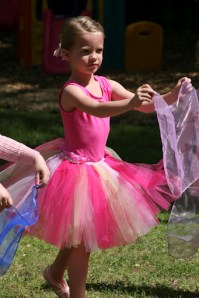
– Scarves (creative movement, free dance, ballet class)
– Maracas or percussion instruments (make ‘music train’ with toddlers / with older students-half of the class makes the beat while the other half dances to it)
– Parachute (toddlers)
– Pom Poms (emphasize arm movements)
– Teddy bears / puppets
– Jumprope (create different movement paths on the floor and mimic them with the body)
– Magic Wands (for littles: tip toe walks, bourree turn with them above heads and grant a magic wish while you arabesque)
– Rhythm sticks (teaching musicality and rhythm)
– Tambourines (again, musicality and rhythm exercises, also hold it in front of your creative movement dancers while they learn battements – try to tap the tambourine, with older children you can hold it up high during leaps and have them try to tap the tambourine while leaping)
– Candy canes at Wintertime (hold them long ways while doing dig heel walks. After executing a cramp roll, tap it on the ground 3x. Place end on floor and walk around it)
– Jingle Bells at Wintertime (shake out a rhythm, then match it with your taps)
– Canes (for a Broadway feel combo)
– Long/large scarves (for Arabian type dances during Nutcracker time)
– Chairs (for different movements-seated, stepping up on, spinning on one leg, etc…)
– Wooden suitcases to tap on
– Serving trays with elastic straps on the bottom to attach to your hands (works great for waitress type dances or Be Our Guest)
– Umbrellas

What props do you use in your classes?

New Music Mondays: Using iTunes to Make Class Playlists

As a dance teacher in the twenty-first century, you can carry thousands of songs in your pocket.

However, just because you can, doesn’t mean you should. Or in our case – at least organize it!

At my studio, I have many teachers who opt for CDs over iPods because scrolling through hundreds of songs to find the perfect tempo for their tap class wastes time and is too frustrating to deal with during class.

And what happens when you forget to take it off shuffle and dance music suddenly crosses over with your ‘personal’ music and you have a taste for raunchy hip hop songs or death metal? Not quite appropriate for those Kindergartners you’re teaching.

I propose a solution!

If you use iTunes, the software allows you make playlists. Use this feature. LIBERALLY.

Here’s how I do it (and you can too!):

1. DANCE MUSIC LIBRARY – Make a playlist for each type of dance you teach. We’ll call these your Dance Library Lists. To make a playlist, click File -> New Playlist. In my case, I have a Ballet, Children’s music, Jazz, Lyrical, Modern, Salsa, Showtunes and Tap playlist.

Then drag and drop music that fits these categories from your Music Library into the playlists. Each of these playlists will have hundreds of songs. Here is my ballet library playlist – it has 200+ songs and full CDs of ballet music.

2. CLASS PLAYLISTS – Now make a playlist for each class you teach. If I am teaching a combination class of tap & jazz, I will often make two playlists. I label mine by the day and time “Tues. 5 – Jazz” or “Tues. 5 – Tap” or “Adult Tap Class”.

Hint: You’ll notice I have my playlists labeled with a number in front of them. iTunes organizes alphabetically, so Thursday will come before Tuesday if you just label it by day. I add the number in front of it because I am anal and need my classes to be in order!

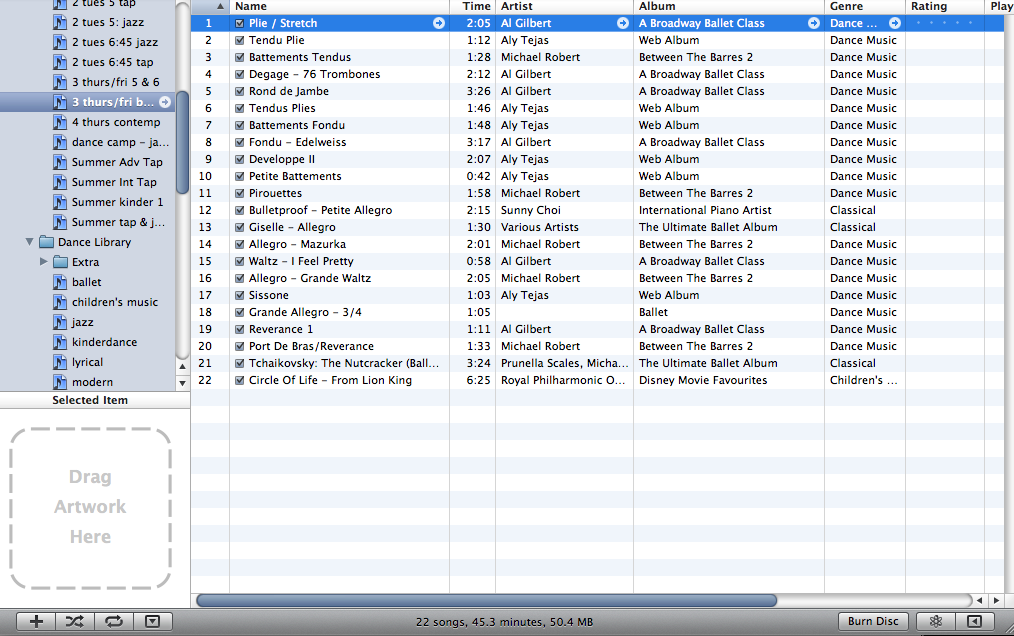
These playlists are much smaller and I often re-arrange them each month or so to bring in new music. To get new music, I just have to go back to my Dance Library Lists and pull a few songs from there. Here is my Thursday/Friday ballet class playlist. It has 23 tracks. Enough to get through the class and then whatever piece of choreography we are working on that day is at the bottom:


Hint: For my tap classes, I organize my playlist by the tempo. This way, I can find the correct speed in class quickly.

3. Use the folder feature. To make a new playlist folder, go to: File -> New Playlist Folder

Label it something useful (Example: “Classes” folder and “Dance Library” folder) and drag and drop your playlists into that folder.Hopefully this organization system will help you to use your iPod during class and you will be able to quickly navigate thousands of songs.

Choreography Playlists
> Choreography: All the songs I am currently choreographing. This makes it easy to find when I am out and want to listen to my songs.

> Potential Choreography: Whenever I hear a song that gives me an idea for a piece, I drop it into this playlist. Even if I can’t use it right away, it’s there, stored away where I can find it.

Hope this has helped you get organized for class!